


We are a family of nine. We left our homeland to sojourn in the Middle East. Through the prophetic scriptures, we have discovered an end-days calling for the protection of a remnant during the tribulation. In this publication, we teach and share about our walks of faith.
Living in the Middle East as a sojourner presents many challenges for day to day life, constantly reminding us of our need to press into our Heavenly Father for provision.
Our need for daily food/bread. Our need for faith, patience, and persistence.
And our need for WATER.
You see, our small city provides water to each residence for only 5-6 hours every four days. Did you catch that? Every four days, they pump water through the city lines for only five to six hours. That’s the water each household gets to last them for the next four days.
If you live in a more “developed” country, like the U.S., this is not something you can relate to. Most likely, you have water continually provided to your home. You have no need to store it and ration it.
Water Storage
In the Middle East, homes are built with a flat rooftop. On the roof, you will find either plastic or metal tanks to store the water. See the pics below.


On the left is a 2000 liter steel tank. This one is on a stand for the purpose of increasing the water pressure that goes down to the home below. Water pressure is often poor inside of homes.
In the middle is a 1000 liter steel tank. It is connected to a solar water heating system. Many homes use solar for their hot water in the Middle East.
To the right is a plastic alternative to metal tanks, which is increasingly being used now to replace steel tanks. It is listed as 2000 liters, made of “food grade” plastic.
We have found there are advantages and disadvantages to each type of tank. The metal tanks last longer and are a little more resistant to temperature extremes than the plastic, whether in the summer or winter.
However, the metal tanks accumulate rust over time and eventually require consistent welding repairs. The water stays cleaner in the plastic tanks because they do not rust.
Our Two Biggest Difficulties: Getting and Rationing Water
We live in a 3-story building. In order for the city water to reach the tanks on the roof of our building, it requires higher pressure than most homes.
And guess what? The city normally does not provide enough pressure. Even if they do, they are inconsistent and literally change the amount of pressure each time they send water.
We have found that unless one of neighbors calls the water department and complains (very loudly), they will not turn up the pressure high enough for it to reach our building.
Most of the homes in the neighborhood are one-story buildings. So these homes have less of a problem getting water because their rooftops are much lower.
People living in our building sometimes go without any water at all, unless they special order it to be delivered to them personally. This costs more money than obtaining water from the city when they pump to everyone.
This has been a nonstop headache for more than four years, since we have lived in our current building.
So how do we get water to reach our water tanks on the roof?
We use a pump and do it manually.
Water Pumping: 10-12 Hours Every Week
I have all the water days in my calendar on my phone. I am very aware when it is a city water day. Every four days, I take 5-6 hours of time to pump water to the rooftop.
Pumps are available at the hardware stores locally.After moving to the building we live in now, we had to purchase one.
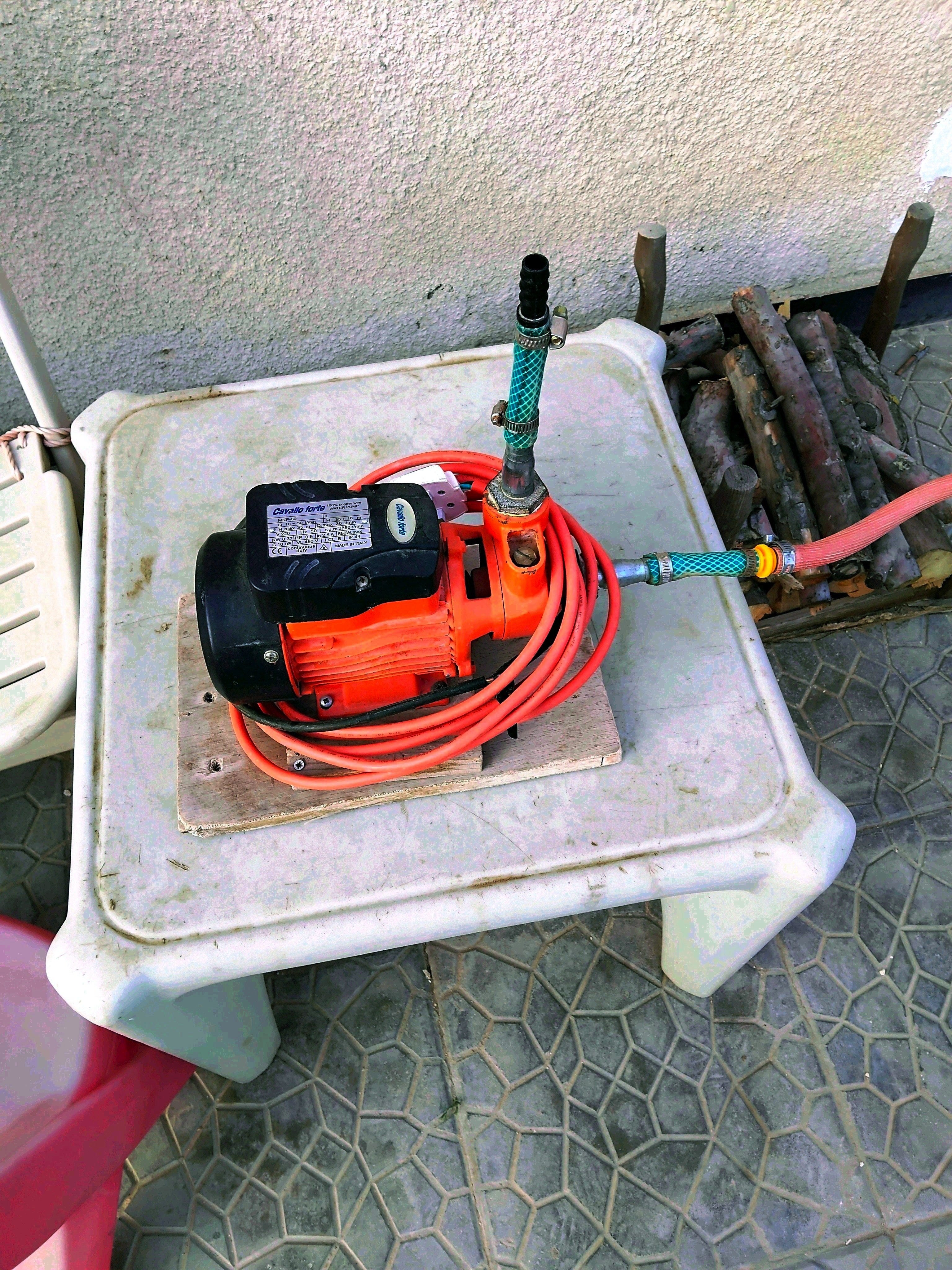
Here is a picture of our pump. You can see we mounted it to a couple pieces of scrap boards. I wired it to a long extension cord and attached various couplings and clamps to make it easy to use.
On a water day, I get help from one of my older sons and another volunteer from the family. It takes three people to efficiently go through our routine of pumping.
I decided to journal throughout a day of pumping to share what a typical “water day” looks like. The following entry is from my notes last week.
Journal for Thursday, February 19th
Today is city water day again. My helpers are my oldest son and my wife. They will do all the work on the rooftop, and I will be on the ground with the pump. Today is very windy, so the temperature will feel chilly on the rooftop.
We will be filling a 1,000 liter hot water tank and two 2,000 liter cold water tanks.-8:05 AM - Set up pump system on the ground and on the rooftop. Looked at our water tanks and saw how full they are and how much water we needed to fill them.
8:25 AM – Finished set up.
8:25 AM – Checked to see if city water has started to come in. None yet. Also checked to see if the neighbors set up a pump of their own.
8:40 AM – Checked for water again. None yet.
8:50 AM – Checked for water. It was coming in! Started the pump system to the roof. Set a timer for 30 minutes for us to check the hot water tank.
9:20 AM – Walked up to the roof and checked the water level. It needed another ten minutes until our hot water tank was full. My wife and oldest son waited on the roof. Winds on the roof were strong and cold, but it was not worth going back downstairs to try to get work done, only to have to return in less than 10 minutes.
9:30 AM - Stopped the pump on the ground. The hot water tank was now full. Switched hose on the roof to a different tank, then turned pump on the ground back on. Set a timer for one hour and ten minutes.
10:50 AM - Went back up to the roof and checked the water level of the tank. The tank was a little over 2/3 full. Set a timer for another 35 more minutes and go back downstairs.
11:30 AM – Went up to the roof. The first cold water tank was now full. Switched the hose to the next tank and begin pumping. Set a timer for one hour.
12:40 PM- Stopped the pumping system for the day. Collected all parts and tried to dry the pump in the sun.
Today was a bit quicker day than most. Why? Because one the neighbors usually pumps as well to several apartments in the building. Their pump has been broken for a couple of weeks now.
They have been ordering water directly from a delivery truck service. As mentioned earlier, this way of obtaining water costs more.
12:50 PM- Today was the first day of Ramadan. Ramadan is the ninth month of the Islamic year. This means most of the locals fast during the day and eat at night after the sun is down.
They have no food or water during daylight. I ran into one of our neighbors while he was watering his olive trees with a hose. His name is Zaid.
He asked me how the pumping was going and he told me that the water problem has always existed for people in our building. He said that we should move because the problem is only for our building and he gets plenty of water onto his roof every time without a problem.
I was happy for Zaid, but of course this was irritating to listen to!
Tension with Neighbors
When the neighbors set up pumps and there are multiple families pumping all in the same building, the flow rate decreases and takes a lot longer for everyone. In addition, one neighbor pumping can cause everyone else in the building to get no water.
This is a continual problem and it causes stress in the relationships between all the families in the building.
The underlying cause is the poor pressure provided by the water department. Since water is a basic need in life, it has a way of bringing forth fears and can bring out selfishness if the will of a person has not been submitted to Almighty God and His provision.
Each person in our building has their own way of dealing with obtaining water. Because of several cultural differences, we have never found a way to come up with a community approach to dealing with the water problem in a way that would benefit everyone.
Romans 12:18 “If possible, on your part, be at peace with all men.”
We pump water ourselves and try our best to always live at peace with the neighbors. It has been quite a challenge. We trust our Heavenly Father to bless our attempts to get water every four days.
Proverbs 5:15-16 “Drink water from your own cistern, and running water from your own well. Should your springs be scattered abroad, rivers of water in the streets?”
One Shower Every Four Days
Our family of nine can shower only one time every four days, once during each four day cycle of receiving water. At most, we can usually run two loads of laundry for our family during this period .
For most of my life, I took for granted the ability to shower. Growing up, I think I showered most days of the week. As an adult living in the U.S., I showered at least every other day, if not every day.
Like most things in life, you take things for granted until you go without it. The last ten years of our life have required many lifestyle changes. Water is one of them.
Regularly going without water for showers or laundry makes my family much more thankful for each shower we get and each load of laundry we can wash. Sometimes, when we get a shower, there is a problem with the hot water system, and we take a shower in cold water, even in winter.
The water trials also make us change how we wash the dishes. In addition, we wear the same outfits for many days in a row.
We have adjusted to this way of living and are thankful for each way we can adapt because it prepares us to endure more trials in the future and to live with more thankfulness.
The ability to adapt to circumstances and go without things makes a person’s character deeper and stronger. We do not clutch on to the “right” to a hot shower. We just gratefully enjoy it when it happens.
James 1:17 “Every good gift and every perfect gift is from above, coming down from the Father of lights, with whom there is no change, nor shadow of turning.”
For those who are paid subscribers, the videos below show you more a personal look into the water day we had last week.